"I Never Thought I'd Be This Strong and Mobile—At 45, I'm Not Done Yet"
Poorna Bell is challenging everything women are told about ageing, fitness and hitting their "physical peak."


"Do you think you'll have children soon?" is a question I became all too familiar with as I prepare for my wedding and simultaneously turn 30. As I get older, the narrative that women are fed from a young age about ageing suggests our lives, and bodies, follow a swift downward arc has only got louder. That there is a peak, and that everything after it is a gentle decline into limitation.
For Poorna Bell, that narrative has never quite held. Now 45, the author and journalist is stronger, more mobile and more physically capable than she has ever been - a reality that directly contradicts everything she once believed about getting older.
Her journey to this point hasn’t been linear. Bell has spoken openly about navigating the profound loss of her husband in 2015, and the ways in which that reshaped her life. In the years since, movement has become something far more meaningful than aesthetics or routine for her. Instead, it’s become a space for rebuilding, for curiosity, and for reclaiming her power.
Through powerlifting and Brazilian jiu-jitsu, something she tells me has a "massive impact" on how she feels as a woman, Bell has not only transformed how she trains, but how she moves through the world. Her approach to fitness - grounded in joy, resilience and self-trust - feeds directly into the themes of her latest book, She Wanted More, which explores what it means for women to expand their lives, rather than shrink them.
Below, Bell shares a refreshing take on how stepping into her forties has redefined what strength looks like, and why it’s never too late to begin again.
Whilst you're here, you might want to check out our guides to the best strength training exercises and how to start lifting weights as a beginner. We also have a wealth of information for you to digest: the benefits of a strong core, the most effective core exercises, the best transverse ab moves, and the best core workouts for the gym, for starters.
“I am stronger and more mobile than I've ever been at 45” - Poorna Bell
Bell is quick to point out just how much of what we believe about ageing is inherited, rather than experienced.
“Everything that I was told about turning 40 and getting older - before I entered it as a decade - was that life would get worse in a number of ways, and one of those was physically,” she says. “That your back would just ache for no reason, and that frailty was your default.”
The reality, she found, was entirely different. “Upon entering my 40s, I discovered that this isn't the case. I am stronger and more mobile than I have ever been at 45, and every year I am surprised that my body can keep going, which only goes to show how entrenched that anti-ageing narrative is.”
Becoming stronger as we age takes work, of course. Bell acknowledges that elite athletic performance has its limits and that recovery can shift with age. But what she rejects is the idea that growth, curiosity or physical capability has an expiry date.
“Although there is absolutely something to be said for an athletic peak if we're talking about competitive sport at an elite level, and recovery times are easier when you're younger, that doesn't mean you can't still try new things or learn a new skill,” she says. “I'm still shocked, for instance, that I learned how to do backwards and forward rolls in my forties.”
And she’s right to question it. Research consistently shows that strength is one of the most trainable physical qualities at any age, with studies finding that women can continue to build muscle and improve mobility well into midlife and beyond - particularly through resistance training.
There's a lot to be said for taking up strength training later in life, too. Research (such as this 2012 study, published in the Journal of Ageing Research) clearly shows that physical activity contributes to increased life expectancy.
Poorna Bell’s top ways to redefine your strength in your forties
1. Embrace being a beginner again
Starting something new in adulthood requires a particular kind of humility - something Bell has had to lean into through both powerlifting and Brazilian jiu-jitsu.
“They've shown me that I am capable of learning something new at any age, but most importantly, they are humbling because they require you to be okay with not being very good at something, at the beginning,” she says. “And they teach you to stick with it and to be patient.”
Brazilian jiu-jitsu, in particular, forces you to sit with discomfort. “In BJJ, no one is good at the beginning, and everyone wonders if their brain is melting because there is so much they don't know from the moves to the terminology,” she explains. But that’s where the shift happens.
“People are kind, and patient, and they will show you how to do things, and over time, you build something and can see that you can learn new things, you can get better if you apply yourself, and that is such a powerful lesson in life.”
For Bell, it's not just about skill, either, but about confidence. “Both sports combined also make a massive impact in terms of how I feel as a woman moving around in this world, which often feels unsafe for women, and makes me feel more confident.”
2. Find movement that feels like joy - not punishment
For Bell, the biggest shift has been moving away from aesthetic-driven fitness towards something far more instinctive.
“Ironically, the thing that scared me the most is the thing that gives me most joy,” she says, reflecting on martial arts. “I love weightlifting, but martial arts reconnected me with my inner child, and a part of myself that I had forgotten, really.”
She continues: “A lot of it is rolling around on a mat, trying moves out with friends and training partners (and then laughing when it goes horribly wrong), and I almost never regret a class.”
That, she says, is the marker of happiness in movement. “To me, joyful movement is when I'm doing something that isn't connected at all to weight loss or aesthetics - when I'm focusing on what I want to do or achieve, and the community that exists in both sports are also a huge part of that.”
And crucially, it’s rooted in self-compassion. “Of course, there are days when I don't want to train, or I'm tired, but I don't punish myself,” she adds. “I do the session (because I think consistency is important), but I also know that occasionally I might give myself a day off, or make myself a nice dinner afterwards.”
3. Question the spaces you’ve been taught to avoid
Strength, for Bell, is as much about mindset as it is about movement - particularly when it comes to the spaces women feel excluded from.
“It has shown me that if we feel like we can't enter certain spaces, or do certain things - physical abilities notwithstanding - then that belief usually came from some arbitrary, random source, usually designed to keep women oppressed and small,” she says.
Weightlifting is one example. “When you think about it, why is it more acceptable for men to lift weights than it is for women? Why is it okay for men to gain muscle but not women?”
Her answer is simple: those rules are meant to be challenged. “When you think that getting stronger literally allows you to do more stuff physically and will protect you from breaking your bones as you get older, why would you not want that for yourself?”
She continues: “It was the same for martial arts. I do freestyle wrestling, and it's very unusual for women to take this up in their forties, even less so as a South Asian woman, where it's not widely acceptable for us to do combat sports,” she says.
“Sure, I might not see women who look like me in this space, but that doesn't mean I shouldn't occupy it. I should be able to step into any space and feel it's mine because I say so.”
4. Redefine what “wanting more” really means
At the heart of Bell’s philosophy is a rejection of the idea that fitness should be about shrinking yourself.
“I was hugely inspired by interviewing older women around their relationship with training and fitness, especially the ones who weren't pro athletes and yet were doing things like weight lifting in their 60s, pole vaulting in their 70s,” she says. “It blew my mind and showed me that everything I thought was wrong.”
What she found, time and again, was that movement wasn’t about aesthetics - it was about something deeper. “When I ran a survey for the book, the biggest ways women said they liked to decompress were to do some form of physical movement,” she explains.
“And so it is really important to women because it usually involves bigger things like realising you are a priority - not just everyone you're taking care of - and maintaining the boundary of that.”
It’s a perspective shift that underpins everything. “For our whole lives we've been told that exercise is first and foremost about aesthetics and weight, and it's just not true,” she says. “That ideology damages so many of us, creates such a toxic relationship with our bodies.”
Instead, she offers a different definition. “I think wanting more has to include wanting more compassion for yourself, more bravery, more joy.”
Shop our MC-UK approved toolkit to building strength now:

After speaking to Bell, it’s hard not to see her approach to fitness as part of something much bigger. Her latest book, She Wanted More, expands on that same idea that strength isn’t just physical, but rooted in how we choose to live, take up space and prioritise ourselves.
Drawing on her own experiences, alongside conversations with women redefining what their lives can look like later on, the book challenges the long-held belief that there’s a “right” way - or time - to come into your own. Much like her journey with movement, it’s less about reinvention and more about permission: to want more, expect more, and build a life that reflects that.
If her story resonates, consider this the deeper dive.

When it comes to strength training, I want pieces that feel supportive without being restrictive - and FP Movement's leggings strike that balance perfectly. The high-rise fit offers just enough hold through lifts and lower-body sessions, while the fabric is soft, breathable and genuinely comfortable to move in.
They’re also the kind of leggings that work just as well beyond the gym - easy, flattering and wearable.
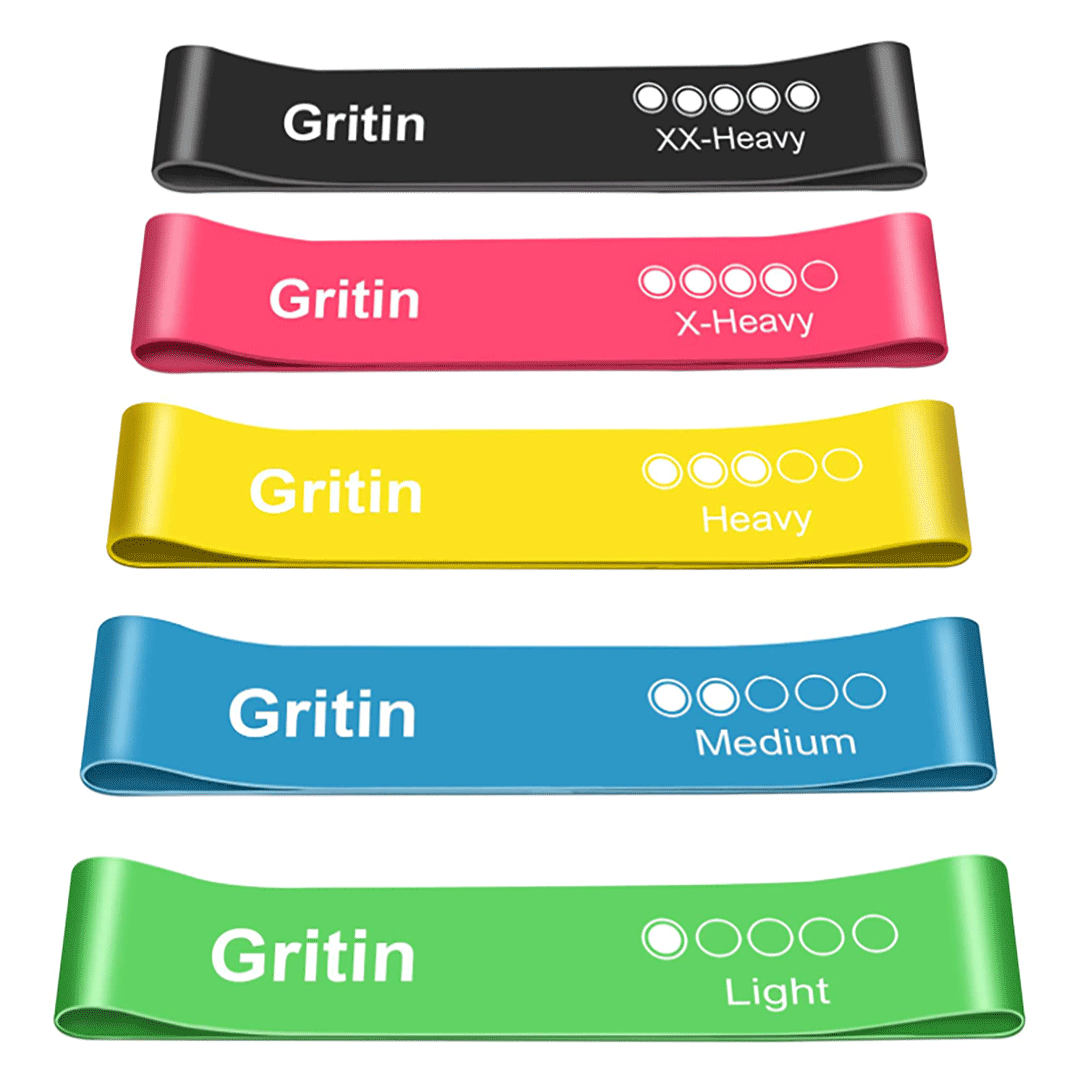
Resistance bands are a fantastic, cheap and portable way to add some load to your strength workouts. This set comes with five skin-friendly bands of varying resistance to suit all abilities, plus a handy carry bag, too.
