I Did a 2-Minute Pilates Criss-Cross Every Day—It's Now My Favourite Home Workout Move Ever
Filing the move away as a "core-strengthener" massively undersells its benefits.


There are some Pilates exercises that have become so recognisable they're basically the face of the whole method. The Criss-Cross - also known as the bicycle - is one of them. It's the move that pops up in every mat class, every online tutorial, every 'beginners guide to Pilates'. Most of us file it away as a core-strengthener and move on. But that undersells it. A lot.
I've tried enough Pilates exercises to know that the moves you often think you know the most are often the ones doing the most work - and criss-cross is a prime example. As someone who spends long hours hunched over a laptop, I'm always drawn to moves that promise more than they first let on. And when I started digging a little deeper into what criss-cross is actually doing, it turns out there's a lot more happening beneath the surface than your average ab exercise.
The science backs this up, too. Research published in the Journal of Orthopaedics and Sports Physical Therapy shows that your deep core muscles are designed to stabilise your body before you move. Criss-cross (when done properly) is one of the few mat exercises that trains exactly that.
Another study, published in Frontiers in Physiology, found that the more precisely you perform Pilates exercises, the greater the oblique muscle activation. This goes some way to explaining why doing criss-cross correctly, rather than going through all the motions, can make such a difference.
And because it's so familiar, it's also one of the consistently rushed-through or misjudged Pilates moves. What looks relatively simple is actually a layered full-body control challenge disguised purely as an ab move.
Curious to see whether there was more to this move than meets the eye, I committed to doing the Pilates criss-cross every day for a week. Keep scrolling to see how I got on, and while you're here, check out our guide to the best Pilates core exercises and ab workouts, as well as what happened when other health writers tried Pilates roll-ups, toe taps, Pilates scissors and heel taps.
Criss-cross is one of the Pilates moves I thought I'd already mastered. Spoiler: I hadn't
What is the Pilates criss-cross?
At first glance, criss-cross looks like a straightforward ab exercise. Lie on your back, curl up, twist side to side. But done properly, it's far more precise than that.
"Criss-cross is a Pilates exercise where multiple muscle groups work together in a coordinated, cross-body movement," explains Noemi Nagy-Bhavsar, Pilates instructor and founder of Beyond Move Studio. "It integrates deep and superficial muscles, creating functional movement that uses your limbs and trunk with rotation for better spinal mobility."
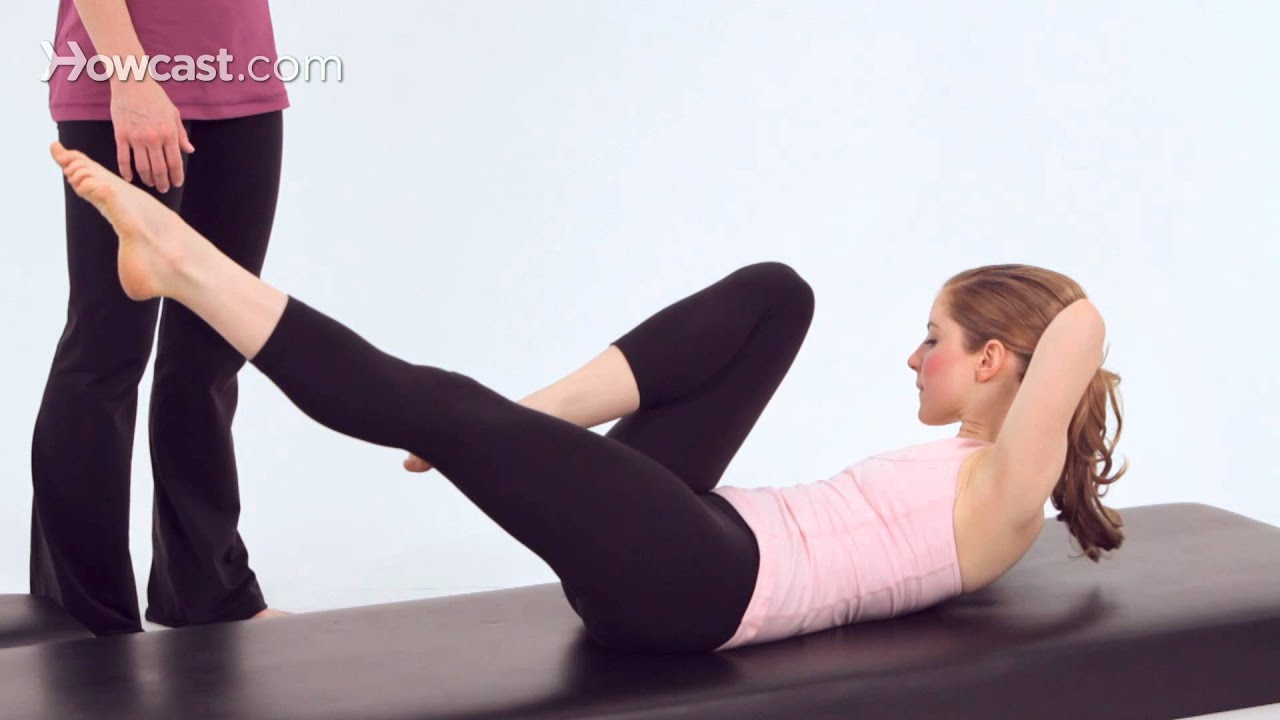
In practice, that means starting in a double tabletop position, bringing your head up into an abdominal prep position, then extending one leg as you rotate towards the opposite knee. As you switch sides, the twist comes from your trunk, engaging both your internal and external obliques. The legs move simultaneously, while the upper body initiates and controls the twist.
As for what it's actually targeting? "Criss-cross targets the obliques - the muscles along the sides of the waist," says Emma Mahama, founder of Everybody Reformer. "Its purpose isn’t just to work the abs, but to train the body to stay stable while the limbs move in opposite directions."
That's exactly what makes it so useful beyond the mat" It mirrors how we use the core in everyday life, twisting, reaching and stabilising at the same time," she adds.
What are the benefits of the Pilates criss-cross?
Like many classic Pilates moves, the criss-cross delivers more than it often gets credit for. Before getting stuck into the experiment, I asked the experts to break down some of the key benefits. Here are four to know about:
1. Builds deep core strength
Probably the most obvious one, but there's a reason the criss-cross is often one of the go-to Pilates workouts. It's one of the few mat exercises that takes deep core engagement and layers it into functional movement.
"It strengthens the obliques and deeper core muscles, which helps support the body rather than just working the abs," says Mahama.
As someone who spends long hours sitting at a desk, that's exactly the kind of deeper support I was hoping to find.
2. Improves coordination and control
"The criss-cross also improves how the upper and lower body move together, so you’re not just going through the motion but actually controlling it," says Mahama.
The challenge is keeping everything working in sync, rather than relying on momentum. Which, if I'm being honest, is the habit I knew I'd been guilty of every time I've rushed through the move in practice.
3. Supports back health and spinal mobility
For anyone who carries tension in the upper back (another common issue for desk workers), this one is worth paying attention to.
"This movement requires high-level rotational control and pelvic stability," explains Nagy-Bhavsar.
The pelvis stays grounded while the trunk and spine mobilise independently, helping to build strength through rotation while supporting the back - something which can help ease tension and improve posture over time.
4. Accessible and easy to progress
Because it doesn't require any equipment, criss-cross is easy to slot into your routine wherever you are.
"Not only is it an energising exercise, but it's also a great progression one," says Nagy-Bhavsar. So you can build it up gradually over time as your strength and control improve - something that quickly becomes clear once you try it.
How to perform a Pilates criss-cross correctly
- Lie on your back and bring your legs up into a tabletop position (knees over hips, shins parallel to the floor)
- Place your hands behind your head, elbows wide, and lift your head, neck, and shoulders off the mat into an abdominal prep position
- Inhale to prepare, then exhale as you extend one leg away while rotating your torso towards the opposite knee
- Return to centre with control, then switch sides, keeping the movement slow and deliberate rather than rushed.
My review of trying the Pilates criss-cross every day for a week
Days one - three
Armed with the experts' tips and advice and keen to see what possible results I may see, I was feeling quietly confident heading into the experiment.
On day one, I started as instructed: lying on my back, legs in double tabletop, hands lightly behind my head. I curled up into an abdominal prep position, stretching one leg forward and rotating towards the opposite knee, concentrating on trying to feel the twist coming from my ribcage rather than my elbows. Almost immediately, I could feel it everywhere - my obliques, deep in my core, and even muscles I didn't realise were meant to be involved. The burn afterwards was hard to ignore. So is the realisation that I'm absolutely overusing my neck.
By day two, I had to remind myself of Nagy-Bhavsar's cues - move from the ribcage, not the elbows and keep the pelvis heavy on the mat. I kept pausing mid-set to reset my position - catching myself rushing, twisting from the arms, and letting momentum take over rather than letting my torso do the work. It was humbling for a move I thought I knew.
By day three, I started to catch myself mid-rep and slow down before it could go wrong, which felt like progress in itself. What looks like a small, controlled movement becomes surprisingly demanding when you actually commit to doing it properly.

Days four - seven
By the second half of the week, something started to shift. While I wouldn't say I was finding it easier, I was finding it smarter. Lying down and bringing my legs up to tabletop position, for the first time, the setup felt deliberate rather than automatic. I curled up, stretched one leg out and focused on keeping the move slow and rotational, with my pelvis firmly grounded and legs switching simultaneously rather than one at a time.
On day five, I noticed I was keeping my pelvis properly connected to the mat without having to consciously fight for it - and the difference was immediate. There was also less strain in my neck. It felt less like an ab exercise and more like coordination training, which is exactly what the experts had been hinting at all along.
By the end of the week, the most surprising thing was how transferable it felt. I'd be lying if I said my core was completely transformed, but I did notice the difference in small, everyday moments - catching when I was rushing through movement, sitting a little taller at my desk, or noticing when I was relying on momentum instead of engaging my muscles properly.
That's the part I hadn't expected. It wasn't just about core strength, but body awareness. Understanding where the movement should come from, and when I was compensating.
So what did I learn? Criss-cross might be one of the most underestimated Pilates moves there is. It looks familiar, but slow down, and it behaves very differently - and that's exactly where the work begins.

Shop MC-UK approved Pilates essentials

We're big fans of BAM for sustainable Pilates-wear - I love wearing a yoga vest. It's lightweight, breathable, and the tie-back and cross-over back detail is really flattering.

When it comes to a low-impact but supportive bra, this lululemon one ticks all the right boxes for Pilates. It's soft, comfortable enough to forget you're wearing it, and the criss-cross back makes it feel more elevated.

If you've been doing criss-cross properly, your upper back will thank you for having one of these to hand. This one's simple but effective (and super affordable).
How often should you perform the Pilates criss-cross?
Criss-cross is one of the most well-known and widely performed Pilates moves, and for many, it's a great exercise to include regularly in your Pilates routine.
"It's one of those exercises where, how often you do it matters less than how well you do it, says Emma Mahama, founder of Everybody Reformer. "It works best to focus on consistency, control and precision rather than trying to do more or move faster. But including it in your weekly training routine will result in a much stronger core."
