Pilates Double Toe Taps Promise to Strengthen Your Deep Ab Muscles in 2 Minutes—So I Tried Them For a Week
Up the ante on your ab work.


If there's one thing I've learned from a decade of Pilates, it's that it never feels easy. There's always a small tweak, modification or advancement that takes moves from this-is-alright to I-can't-do-this-any-longer, and, as well as being one of the reasons I love it so much, it's a great way to keep us humbled.
The Pilates double toe tap is a case in point: while I may have mastered (it's a strong word, but I'm going with it!) the single toe tap, it's double -sided sibling is a whole different ball game. So, when I was asked to try doing them every day for a week, it was with some trepidation that I agreed.
And the reason I was convinced? The double toe tap is an advanced move that challenges all the skills a consistent Pilates practice develops: core strength and stability, control and mobility.
"Double toe taps are one of those deceptively simple Pilates exercises that really get to the heart of what the method is about," agrees multi-disciplinary trainer Tara Riley. "It’s a small movement, but when done well, it feels incredibly strong."
But don't just take my word for it. While studies on the double toe tap in particular are thin on the ground, it's well established that Pilates generally is beneficial for both mental and physical wellbeing. Take this study, from the journal Healthcare (Basel), which shows that Pilates boosts core muscle strength and can help to prevent lower back pain, while further research (such as this review, published in the journal Archives of Rehabilitation Research and Clinical Translation) reveals the method's efficacy in improving posture, strengthening and mobilising the spine and surrounding muscles.
Suffice to say, I couldn't wait to get started - keep scrolling for my thoughts, but in the meantime, do check out our guides to the best Pilates workouts of all time, the best Pilates moves for building muscle, the best Pilates moves for runners and find out how one Health Writer got on when she tried Pilates scissors every day, here.
Pilates double toe taps are an advanced move worth your time - here's why
What are Pilates double toe taps?
If you're familiar with the single leg toe tap, a Pilates double toe tap won't be a tricky concept to grasp. The move is fairly simple, as instructor and founder of Sync with Georgia, Georgia Weibel, explains.
"Double toe taps are a core-focused Pilates exercise where you start lying on your back with your legs in a tabletop position, knees bent at 90 degrees," she tells MC UK. "From there, you lower both feet down towards the floor at the same time, lightly tapping the toes, then bring them back up to table top."
While it may sound like a leg and foot-based move, in fact, this one is all about the core. "The key is keeping your core engaged and your lower back stable throughout," notes Weibel. "It’s not just about moving the legs, it’s about controlling the movement from your centre."
So far, so simple sounding - but don't be fooled into thinking this move will be easy; but as with all things Pilates, with effort comes reward - and the benefits of a double toe tap are worth the work.
What are the benefits of Pilates double toe taps?
So, once you've mastered the move, what can we expect in the way of benefits? You'll be pleased to hear that they are plentiful.
1. They engage and strengthen the core
First and foremost, Pilates double toe taps are a deep core move, and as such, they work to engage and strengthen what's known in the practice as our 'powerhouse'.
"Double toe taps are brilliant for activating the powerhouse, particularly the lower abdominals, which can be a notoriously tricky area to connect to," shares Pilates instructor Aleksandra Warburton. "They help build deep core strength, improve pelvic stability and teach control through the hip flexors without overloading the lower back."
2. They promote stability and control in the body
Much of the work in Pilates is around improving stability and control within the body, and a strong core is central (quite literally!) to this. Double toe taps require a solid base and good core control, enhancing our awareness of those deep stabilising muscles in and around the spine.
"Because a double toe tap requires you to move both legs at once, they challenge your ability to stabilise through the pelvis and lower back," notes Weibel. "Over time, this helps improve overall core control and posture."
3. They enhance functional movement
"Pilates double toe taps help to improve what's known as hip dissociation," shares Brittni Johnson, Pilates instructor at wellness app BetterMe. "This is essentially the ability to move your legs independently of your torso, which is essential for healthy posture and functional movement in daily life."
4. They're low impact
Pilates is a low-impact activity, making it particularly suitable for people with joint issues.
"Unlike many forms of core work, Pilates double toe taps are low-impact, so they’re a really effective way to strengthen the core without putting pressure on the joints or spine when done correctly," notes Weibel.
5. They're simple but effective
"When done well, double toe taps are simple, effective yet surprisingly challenging," says Warburton. "They're a great reminder that in Pilates, it’s often the smallest movements that deliver the biggest results."
6. They enhance overall body awareness
"When performed correctly, they also support better coordination and body awareness, making them a valuable addition to both Pilates and general strength routines," notes Warburton.
How to perform Pilates double toe taps with good form
As with all Pilates moves, form really is key, not only to harnessing the gorgeous benefits of a double toe tap, but also to ensure you don't hurt yourself in the process.
"A Pilates practice should feel quiet in the body," advises Riley. "There should be no gripping and no strain- just controlled, supported movement. I suggest the following:
- Start on your back with your knees in tabletop (90 degrees at the hips and knees) and arms long by your sides.
- Before you even move, take a moment to settle: soften the ribs, feel the weight of your pelvis, and gently draw in the abdominals.
- As both feet lower away, focus on keeping the pelvis completely steady.
- Only move as far as you can without the lower back wanting to arch.
- Keep breathing, try not to hold your breath.
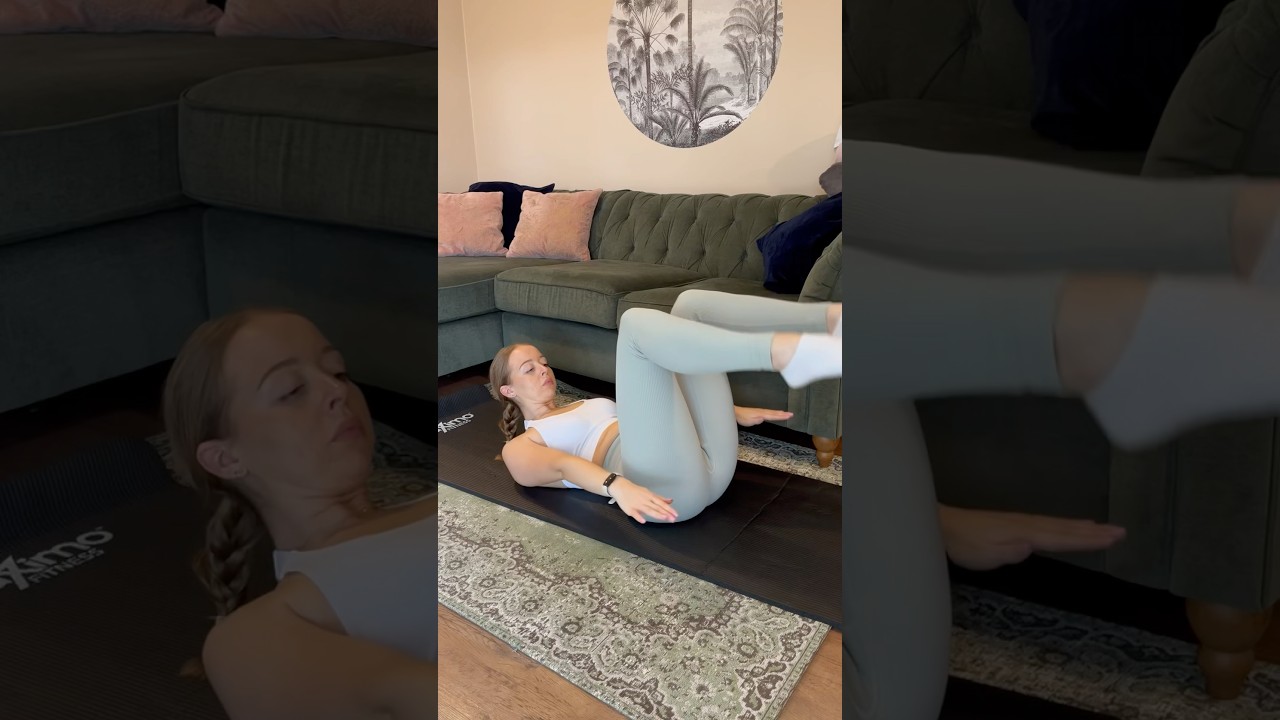
I tried Pilates double toe taps every day for a week - here are my honest thoughts
Days one to three
If you're a regular MC UK reader, you'll know that we all love a daily workout challenge, and for me, they don't get much better than an advanced Pilates move - so I was keen to get cracking on day one.
I serendipitously timed the start of the challenge to coincide with my weekly mat Pilates class, so I was able to grill my instructor for tips on form and technique, which, as it turned out, were invaluable, given it's a fairly technical move (even if it looks super simple!)
And lo and behold - I felt the burn almost immediately. Even though I'm well acquainted with the single toe tap (another stellar core move), I'm surprised at how tough I find the double - possibly because I have my teacher making minute adjustments to my form - but I do genuinely believe that this is what makes Pilates so tough, and also why it's crucial to have a good instructor, too.
I only manage about five reps, and I'm ready to roll up my mat for the day - but I did tack them onto the end of my class, so I'm hoping that when my muscles aren't so tired, the move might feel (slightly) easier.
On day two, I decide to try popping a Pilates ball between my knees, as I know this is a great way not only of ensuring I engage those tough-to-reach inner thigh muscles, but also to help me keep my legs aligned. And the ball gave valuable feedback - those little wobbles are magnified, meaning I discover that I'm inclined to lift my right hip slightly, something I keep in mind as the week goes on.
I'm surprised that I don't get my toes as close to the floor as I thought I would (making the move more of a toe float than a toe tap!), but I'm assured by the experts that this is perfectly acceptable, since lowering any further would risk compromising my form.
"Only lower as far as you can without the lower back arching or the ribs lifting," advises Warburton. "The key is to move from the hips, rather than the toes themselves, while keeping the middle body steady and the core engaged, aiming for the movement to be smooth and controlled."
Days four to seven
I start day four with Warburton's advice firmly at the forefront of my mind, and really focus on keeping my ribs and lower back connected to the mat as I flex my leg and foot away. I find it helpful to imagine the waistband of my leggings pushing into the mat, as this keeps my deep core really switched on.
And a switched-on deep core means that infamous Pilates shake isn't far away, forcing me to work on my stability, as promised. Do I feel it in my core? Absolutely. And I'm surprised to find that I also feel it in my obliques, too, proving the move really is a whole core challenge.
By the end of the week, I'm ready to up the ante again, and I choose to slow the movement right down, focusing on upping that time under tension. And do I feel it! For a move that looks so easy, it's actually amazing how tough it can feel.
So, would I recommend Pilates double toe taps? If you're a Pilates regular looking for a fresh challenge, absolutely. But for anyone else, I'd definitely advise polishing up on the single-leg version first! As always with Pilates, the magic is in the small movements - and the old adage rings true; if you can't feel it, you're probably not doing it correctly!
I promise you'll thank me later....
Shop MC UK's essential Pilates kit now:

Adanola is a firm team MC UK favourite, and for good reason: they offer stylish activewear that's fit for purpose, too. We love the ultimate range, and this bra lives up to the hype.

A soft and comfortable pair of leggings is a must for making your Pilates practice as smooth as possible. We love the BAM range, not only for their style and substance, but also for their sustainability credentials, too.

A Pilates essential, a good pair of grippy socks will keep you stable and grounded, whether you're on the mat or Reformer.
Can I modify the Pilates double toe tap to suit my ability?
"Absolutely - with Pilates, there’s always a way to meet your body where it is," advises Riley. "I tend to build clients up to double toe taps rather than starting there because it’s important to first understand how to stabilise the pelvis and engage the deep core.
"To modify, start with single toe taps, or limit how far the legs lower. Even the smallest range can be incredibly effective if you’re maintaining that deep connection.
"Next, to progress, try lengthening the legs as they lower, add a gentle curl of the upper body, or simply slow everything down. Slowing it down is often the biggest challenge, and where the real work lies."
