I'm an 11-Time Marathoner Who Just Ran My Fastest Time Ever—I Swear This Handy Nutrition-Tracking Device Made the Biggest Difference
Taking the guesswork out of fuelling, once and for all.

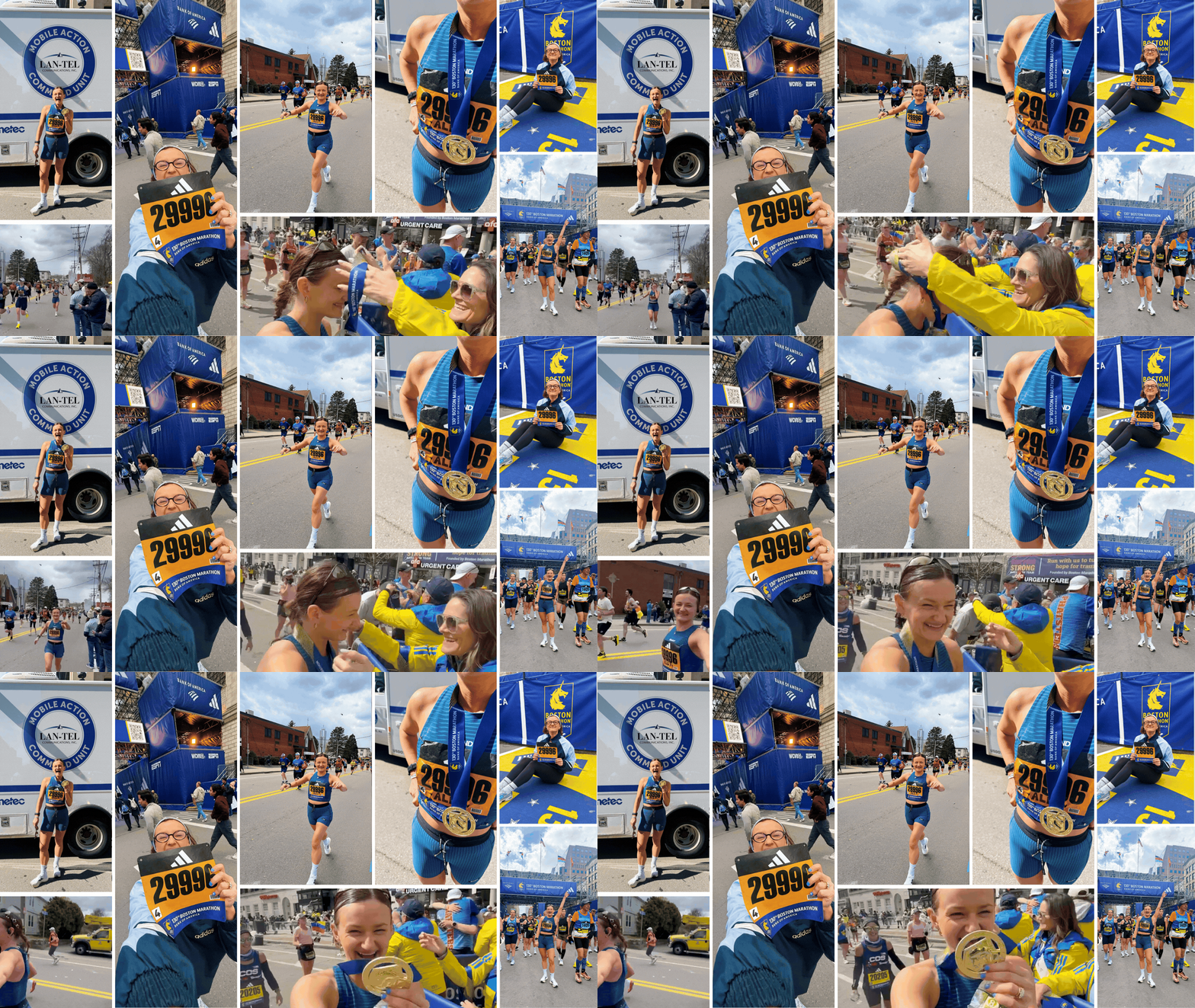
Last month, wearing head-to-toe blue, gels strapped to my waist and star clips in my hair, I ran the 130th Boston Marathon. It was the race of a lifetime; as an eleven-time marathoner, it was everything I could have dreamed of and more. Everything fell into place, and I came away with a shiny new five-minute personal best despite a significant elevation of nearly 1000 metres.
But let’s rewind a little, before I share more of my Boston story - because I’ve been a runner for most of my adult life. It helps me process, unwind, and never fails to boost my mood - it’s changed my life, shaped who I am, and made me lifelong best friends, along the way.
So you can imagine my devastation when, in December 2024, I broke my fifth metatarsal. The doctor’s instructions were clear - rest, ice, and elevation, and no running for a minimum of three months. I quietly started my rebuild - think hours (and hours, and hours) on the indoor bike, more calf raises than I care to count, and plenty of seated resistance band exercises, too. By April, I’d run my first half-marathon. And by December, I was on the start line of the Valencia Marathon, grateful beyond measure to be back doing what I love.
On paper, it’d been a perfect training block and I felt really confident. But the race was the only marathon I’ve run that I haven’t enjoyed. I got a pretty debilitating stitch from around mile six, which escalated into a full abdominal tear. Despite finishing with a PB, I left with more questions than I started with.
Had it been a strength issue? A fuelling error? Or was I simply not cut out for the distance after so much time off? That’s why, when Pamela Nisevich Bede, Global Nutritionist at Lingo by Abbott, reached out to offer her expertise ahead of my 14-week Boston Marathon training block, I leapt at the opportunity. I’d never had a nutritionist on hand to answer my fuelling questions before, and I’d be wearing an in-arm Lingo Glucose Biosensor to monitor how my body was actually processing the fuel I was consuming for my workouts.
To say this process was transformative probably undersells it. I’ve long been a fan of CGMs, wearing them for about twelve months back in 2023 as part of my PCOS journey, but I’d never quite understood how to eat for PCOS alongside fuelling for running (and the PBs I’d worked so hard for). The process with Lingo and Bede taught me exactly how to do it - and, if the five-minute personal best isn’t proof, I don’t know what is.
Let’s get into it.
What is a Lingo Glucose Biosensor?
A Lingo Glucose Biosensor is a small, wearable continuous glucose monitor made by global healthcare company Abbott. Designed to be inserted into your arm, it tracks your glucose levels day to day and provides handy in-app prompts and suggestions for minimising glucose spikes and maintaining stable energy levels.
It’s quite neat, actually - a small sensor sticks to the back of your arm with a tiny filament sitting just under your skin. Once it’s been inserted, it monitors the glucose in your “interstitial fluid” and then sends readings to the Lingo app via Bluetooth
Loads of things can impact your glucose spikes throughout the day - stress, sleep, food, exercise and more - and, as with everything in life, balance is key here. Some spikes will happen, but observing what causes the biggest ones and making dietary tweaks can not only be empowering but also boost your metabolic health.
How is a Lingo Glucose Biosensor useful for runners?
Good question - and one I’ll admit I had my own reservations about, when I hopped on my first call with Bede back in January. “Continuous glucose monitoring with Lingo offers endurance athletes real-time visibility into their body’s fuel needs and a peek at how their body is responding to training and nutrition,” the registered nutritionist shares with Marie Claire UK.
This is the part that appealed to me the most - instead of guessing, as we do with so many other aspects of our nutrition and wellbeing, you can actually see how your glucose levels shift before, during and after your sessions. While glucose tracking is only one part of the puzzle, it does enable you to use this data to fine-tune a nutrition plan that works for your health and performance. As Bede says, “Real-time data plus countless insights result in a more robust understanding of whether you are adequately fuelled.”
For marathon runners, this might look like smarter pre-run fuelling decisions, better timing and quantity of carbohydrate intake during long runs and faster and more effective recovery after sessions. “Ultimately, it helps athletes train with greater consistency by avoiding both under-fuelling and large energy dips,” she shares.
How can experts use data from the Lingo Glucose Biosensor?
“As a sports RD and metabolic health expert, I rely upon CGMs as a tool to guide your approach to fueling and evaluate what’s going on behind the scenes with your metabolic health,” she explains.
That’s because glucose data allows experts to move from generic guidelines to truly personalised fuelling strategies - think of it as a real-time insight into how your body is actually using and responding to the carb gels, snacks, and bars you’re using during your training runs.
“Rather than providing a range of 30 to 60 grams plus of carbohydrates per hour during long training sessions and racing, we can better pinpoint when to add in fuel, how much is needed to fuel the effort, and the cadence which is needed in order to keep energy steady and effort strong.” Pretty neat, right?
Month one
Hopping on my first call with the registered nutritionist, my main question is simple: how should runners balance the glucose spikes that simple carbohydrates cause with their benefits as an easily digested pre-run fuel? “While invaluable, glucose is one metric and one piece of a complex puzzle,” she explains. “It should be used alongside how the athlete feels, as well as their performance and broader nutrition goals and habits.”
In short, you’ll need glucose (most easily digested in the form of simple carbs - think bread, bagels, pasta and so on) to fuel your muscles while you run. And simple carbs consumed without other food groups, like protein and healthy fats, are most likely to cause glucose spikes. But Bede reassures me that glucose variability is normal and expected, and this process wasn’t about observing singular spikes; rather, accumulating enough data across training sessions to understand my body’s response to nutrition and training demands.
As she finished up our call, she stressed the soundbite that stuck with me the most: that rises in glucose can actually be beneficial, especially for runners. “Spikes around exercise signal glucose being sent to working muscles where it’s used to fuel the activity – which is a good spike.”
So, tracker in arm and app downloaded, I set about my training. The plan for the first month was simple: to eat, move and fuel as I normally would to collect data for Bede to analyse. Simple enough...

Some of Ally's Lingo data from month one.
Month two
After a month of tracking my glucose data and sending the insights to Bede, I couldn't wait to hear her observations.
She’s flattering about my commitment to my training, but noticed that I was likely underfuelling a little, and that my glucose levels tend to dip earlier than expected on longer sessions. As a result, she suggested that I’d benefit from fuelling slightly sooner and more consistently. “Consistency during runs improved outcomes,” she shared. “A more structured fuelling cadence, such as fueling every 20 mins with bits of fuel versus a bolus of fuel every 60 mins, helped maintain a steadier glucose ‘plateau’, rather than fluctuations that could impact performance and perceived effort.”
Fuel type made a difference, too - as it turns out, I tolerate gels more than bars, and they supported more stable energy, too. Unsurprisingly, blended foods (like smoothies) caused sharper spikes as they’re quick to digest as opposed to whole foods, such as a banana.
She also encouraged me to wake up slightly earlier on my mid-week sessions and eat a more well-rounded breakfast, like a bagel, peanut butter, and a banana 90 minutes before my session. “Timing was key to avoiding reactive patterns. You had two effective options: fuelling 90–120 minutes before a run to allow glucose to rise, be absorbed, and settle, or fuelling closer to the session during an active warm-up, using easily digestible options like gels or sports drinks rather than bars.” I was in the habit of grabbing a carb bar on the way to my interval session, but after seeing my glucose soar to eye-watering highs one morning after reaching for my usual bar (and subsequently come crashing down), on the mornings when I simply didn’t have time, I reached for a gel, instead, knowing that my body could digest those better and would leave me feeling more energised throughout my session.
Alongside the physical observations, Bede gently reminded me that I’d go further with my training if I mentally reframed pre-run spikes. As someone with PCOS, I’ve eaten to minimise glucose spikes and reduce inflammation for the best part of three years - so to now be reapproaching this from a run-centric perspective took some getting used to. “Larger spikes from pre-session bars weren’t inherently negative - they reflected rapid energy availability as one would expect the product to deliver,” she explains. “They did highlight the need to focus less on last-minute fueling and working to avoid spikes and more on starting sessions well-fuelled.”
She also reminded me that day-to-day variability mattered. Stress, hydration, sleep and hormonal factors (including my PCOS-related variability) all influenced my glucose responses, which only reinforced the importance of spending time with glucose steady and in a healthy range outside of training windows.
Overall, my data reinforced that effective fuelling isn’t about eliminating glucose rises, but about using them strategically - ensuring I have energy available when I need it, while keeping patterns more stable outside of training to support recovery and consistency.

One of Ally's pre-run breakfasts, and one that kept her blood sugar more stable than a simple carbs - a wholegrain bagel, banana, and peanut butter
Month three - race day
Come April, I really felt I’d got in the swing of things with my fuelling and had plenty of time to test Bede's suggestions. My biggest achievement of the training cycle came at Reading Half Marathon, a training run mid-marathon block, which ended with me coming away with a half personal best I’d been trying to achieve for over three years.
That race, I did exactly as instructed: two crumpets, peanut butter and banana 120 minutes before, a SAP gel 15 minutes before the start with a focus on little and often, and a Maurten 100 gel every 5km. This was a ramp-up from my old rule of thumb, where I aimed for a gel every 25 to 30 minutes (around eight to nine gels per marathon for me, vs seven to eight).
I executed a similar plan on race day. Another element that I’d discussed at length with Bede was my aversion to tracking - in Valencia, I’d tracked my carb load in the days prior to the gram and ultimately, I think, I over-carbed (if such a thing can happen). Despite preaching day in, day out, never to try anything new on race day, I got sucked into the social chat, sticking to a hard-and-fast ten to twelve grams of carbohydrates per kilogram of body weight per day in the 36 to 48 hours prior. But my body simply wasn’t used to it, and I ended up feeling bloated and getting the dreaded stitch on race day.
For Boston, I carb-loaded intuitively and as per my Lingo guidance. I aimed for little and often throughout the day, didn’t track my macros, and instead just ate carb-focused meals that I loved (easy in the USA, I’ll tell you). Breakfast the days before looked like porridge, pancakes, or bagels with some fruit, lunch, a mozzarella sub from Monica’s Mercato, which claims to sell Boston’s most famous subs, and dinner, pasta with chicken, garlic bread, and some salad. Our hotel, Boston InterContinental, even hosted a dedicated marathon runners pasta party, making night-before fuelling effortless.
The morning of, I had a bagel with a banana and honey. On the way to the start line and as per Bede's guidance, I had another bagel and honey. An hour out, I had a banana, and 15 minutes before we kicked off, I had a SAP gel. As with Reading Half, I aimed for a gel every 5km on the dot.
While there are a multitude of variables that can impact your race day performance, I can confidently say I’ve never felt so comfortable, well-fuelled or strong during a marathon before. I was easily able to take on my gels (every runner's dream), never felt tired or like I was hitting the dreaded wall, and even managed the infamous 1000m of hills (including Heartbreak Hill) without slowing my pace.
And best of all? I didn't experience even a hint of a stitch, which so nearly floored me in Valencia just four months prior.
As a woman who spent most of her 20's undereating, it felt pretty special crossing that finish line having fuelled in a way I knew worked for my body. No guesswork, no questions, just a clear and data-driven plan to execute - which I did. It was euphoric, emotional and exhilarating - I'll never, ever forget it.
I learnt more about my body and what I need to adequately fuel my runs than I have in the ten years of being a Health Editor and runner. While I’m all for eating intuitively and listening to your body, sometimes, leaning into the data can be empowering beyond measure and enable you to reach levels you’d once dreamed of.
So, if you’re on the fence about your run fuelling or keen to learn more about what works for you, I can’t recommend Lingo enough. If you’re anything like me, it might just be the key to your next PB….

Senior Health Editor Ally Head at mile seven of the 130th Boston Marathon 2026
Shop Ally's marathon training favourites now:


