You've Been Unfriended On Facebook. Now What?
'She's deleted me!' How to handle being unfriended on Facebook
'She's deleted me!' How to handle being unfriended on Facebook
Friendships are good for your health. Fact. But in an increasingly connected world, where we clock up as many as possible - then unfriend them on Facebook just as quickly - how do we nurture the valuable ones and face up to the time-wasters
- How it feels to be unfriended
- What our Facebook 'number' says about us
- How many friends is too many?
- How to bounce-back from an unfriendship
She had a ‘Don’t screw with me’ strut, a job I coveted and amazing Acne boots: it was girl crush at first sight. Eight years older, she was also a big-sister-cum-mentor. Career advice was dispensed over after-work drinks, plus salacious tales of her single-girl sexploits. Newly married and in a professional rut, I was fascinated by her otherness, while she revelled in my need for guidance. But the honeymoon period was short-lived and, after a few months, our love-in petered out and I had been unfriended on Facebook. No explanation, no drifting apart – the party venue had changed, but no one had told me.
Celebrity news, beauty, fashion advice, and fascinating features, delivered straight to your inbox!
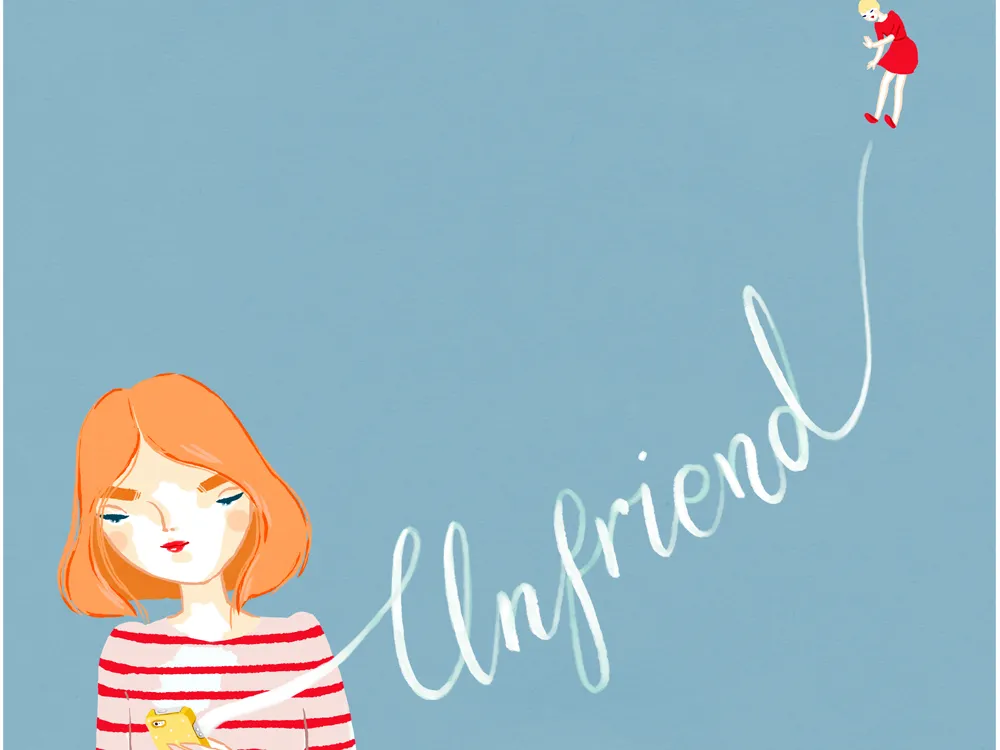
Image by Kris Atomic
Status update: Hey, where did all my friends go?
‘My confidence took a massive hit,’ agreed my friend Sophie, 26, an accountant, when she was frozen out by one of her closest friends, who stopped inviting her on nights out or returning her calls and she was unfriended on Facebook. ‘I’ve always wondered why Bethan pulled away and I still don’t know. The fact that there was no opportunity for closure still plays on my mind years later.’
This feeling of rejection can be likened to a form of grief, according to Dr Amy Banks, a neuropsychiatrist at Wellesley College, Massachusetts. ‘Research shows that when you’re socially excluded, an area of your brain indicates distress. This same area is triggered when you’re in physical pain.’ In her latest book, Four Ways To Click: Rewire Your Brain For Stronger, More Rewarding Relationships, Banks examines the four neural pathways to the brain that encourage closeness and connection. ‘There’s a specific nerve that relates to feeling accepted, and the more you stimulate it with healthy friendships, the stronger it becomes. If you stop stimulating, it shrinks and withers away, leaving you isolated and unhappy.’
How to lose a friend in ten days
It’s natural to shed friends over the course of a lifetime as our circumstances change, but friendship in 2015 is more cut-throat than ever before. I have one Facebook friend who sends alerts to congratulate you on surviving his virtual cull. And if you don’t get struck with the ‘defriend’, there’s always ‘ghosting’ – keeping up the appearance of friendship on social media, via status likes and wall postings, while seeing little or nothing of your friend in real life. But has the cultural shift towards virtual friendships devalued their place in our human lives?
‘The size of your social network and how well integrated it is has a bigger effect on your physical health than anything else except giving up smoking,’ claims Professor Robin Dunbar, an evolutionary psychologist at Oxford University. ‘In a study on heart attack patients, the more friends the patient had, the more likely they were to survive another year.’ According to Dunbar, feeling connected to a strong support network releases endorphins, ‘the brain’s own painkillers’, making you less susceptible to illness.
Britons spend an estimated 62 million hours each day on Facebook and Twitter, yet instead of feeling more connected, research indicates we’re in the midst of a loneliness epidemic: a quarter of adults aged between 25 and 34 admit to feeling socially isolated. Millennials characteristically demand it all: career success, hot sex lives and a multifaceted group of mates. But as our networks expand (people have, on average, 338 Facebook friends), the less time we have to devote to meaningful friendships.
How many friends is too many?
Twenty years ago, Dunbar devised the Dunbar Number – the optimum number of social relationships you can maintain at any given time. On discovering a correlation between the size of primates’ brains and the size of their social groups (for monkeys, grooming is socialising), he applied the results to the average human brain size and concluded that the maximum number is 150. He argues that the advent of social media has had little impact on this figure. ‘If you look at the Domesday Book, the average village size was close to 150,’ explains Dunbar. ‘The number depends on the size of our brains, and our brains haven’t increased much in 100,000 years.’ So in theory we all have 138 surplus ‘friends’.
In 2014, almost 95,000* British couples turned to relationship or marriage counselling, but perhaps we should be investing similar efforts into saving our flailing friendships. Relationship psychologist Susan Quilliam offers counselling sessions to friends going through rough patches, seeing clients both individually and together, to assess their issues. Most commonly, they occur when one friend enters a different life stage and the other feels left behind, or when one feels taken for granted or jealous. ‘Almost all the themes are the same [as married couples], and the solutions can be, too.’ Susan recommends talking honestly and without holding back or apportioning blame. ‘The aim is to understand one another, not to prove a point. It works best if you are both clear about what practical changes will help the friendship to survive, i.e. meeting more often, listening more and seeing each other without your partners.’
When Tess, 30, a corporate account manager, fell out with her best friend of 17 years, Kim, at Kim’s hen night two years ago, she had no idea it could be terminal. ‘It was a drunken misunderstanding that got out of hand. I’d lost a good friend to cancer a few months previously and Kim was really stressed in the lead-up to the wedding, so emotions were running high. When Kim accused me of ruining her hen do, I was devastated.’
Kim got married a few months later and placed Tess and her husband on a table towards the back, instead of on the top table as originally intended. ‘I had emailed her to patch things up, and we’d agreed to move on, but at the wedding I felt like a total stranger and it broke my heart,’ says Tess. The pair eventually tackled the issue through a frank discussion over dinner one evening. ‘We talked honestly for the first time ever, listening to what the other person had to say without interrupting,’ says Kim. ‘It was a difficult conversation, but neither of us were prepared to turn our backs on 15 years of friendship.’
It's over. Now what?
Before deciding to call time on a friendship, Quilliam advises categorising all relationships into concentric circles. In the centre, you might have immediate family, then a group of core friends you can be emotionally intimate with. After that, there may be a circle where each friend has ‘specialisation’, for example, someone you turn to for work advice. The final circle will be those friends you don’t see often, but still have affection for. ‘Not all friendships will give you everything you need, and that’s OK, but there’s value in working at a good friendship rather than letting it go,’ adds Quilliam.
Of course, knowing when to call time on a friendship is equally important. Three years ago, Kat, 28, a TV producer, decided to cut ties with her oldest school friend, Anna, after falling out over mutual friends. ‘I found the other girls toxic. They talked about everyone behind their backs. I needed to distance myself from them, but Anna refused, so sadly I had to let her go, too. I’m much happier now they are out of my life – even Anna, surprisingly. Being around her would bring back too many painful memories.’
Weighing up the true value of a friendship is essential before embarking on a cull, says relationship psychotherapist Jan Slater. ‘If a friend has done something unacceptable like, say, breaking a confidence or dating an ex-partner, you need to check the facts calmly first, then tackle the issue head-on by telling them how you feel,’ she advises. ‘It’s the only way to save a friendship that’s gone bad. Equally, not all friends are forever and you shouldn’t feel bad about allowing some to drift away. In those scenarios, thank Facebook for the unfriend button.’
The leading destination for fashion, beauty, shopping and finger-on-the-pulse views on the latest issues. Marie Claire's travel content helps you delight in discovering new destinations around the globe, offering a unique – and sometimes unchartered – travel experience. From new hotel openings to the destinations tipped to take over our travel calendars, this iconic name has it covered.