I Tried XERF, the Skin-Tightening Treatment Everyone Is Talking About—Here's My Verdict
Promising firmer, lifted skin without needles or downtime, XERF is generating a lot of excitement, but can it really deliver?


Never in my 15-plus years working in the beauty industry have I witnessed quite as much excitement surrounding an aesthetic treatment as I have with XERF. Frankly, I struggled to understand why. On paper, it doesn’t sound particularly revolutionary. XERF is a radiofrequency treatment that promises tighter, more lifted skin without needles, discomfort or downtime. It’s an appealing proposition—but it’s hardly an unfamiliar one. The aesthetics industry has been making similar promises for years.
Initially, I assumed it was another high-tech device being enthusiastically promoted by clinics that had just invested thousands of pounds in acquiring one. But then dermatologists, aesthetic doctors and industry insiders whose opinions I genuinely respect started waxing lyrical about its benefits, and my interest was piqued.
At Marie Claire we don’t deal in hype, but we do extensively test (almost) every new aesthetic treatment in the interest of being able to confirm whether it’s worth your time and money, so I booked an appointment to investigate. What follows is my unfiltered review, with one important caveat: the full results aren’t expected to become apparent until around eight weeks post-treatment. I’ll be updating this review as they develop, so consider this the first instalment rather than the final verdict.
What Is XERF?
XERF is a non-invasive radiofrequency treatment designed to improve skin firmness and address early signs of laxity. It works by delivering controlled thermal energy into the skin and underlying tissues, stimulating collagen remodelling—the process by which existing collagen is reorganised and new collagen production is encouraged.
As we age, collagen production naturally declines, causing a gradual loss of skin firmness and elasticity. XERF claims to counter this by heating the tissues at different depths, encouraging a firmer, more supported appearance over time.
“XERF represents an interesting evolution in non-invasive skin tightening because it uses dual-frequency monopolar radiofrequency technology, combining 6.78 MHz and 2 MHz frequencies to deliver controlled heating at different tissue depths,” says Dr Ahmed El Muntasar, NHS GP and award-winning aesthetic doctor.
The important distinction is that XERF isn't intended to transform facial anatomy or replace a facelift. Its particular selling point is improving the appearance of skin laxity and definition without the recovery associated with more invasive procedures.
How Does XERF Differ From Other Radiofrequency Treatments?
Energy-based skin tightening is not new. Treatments such as Thermage and Morpheus8 have been used for years, as have ultrasound-based devices such as Sofwave, which offer another approach to stimulating collagen.
What sets XERF apart is its combination of two radiofrequency frequencies and the adjustable settings, meaning your practitioner can tailor the treatment to your individual skin needs and comfort levels.
“Unlike Morpheus8, which uses needles to deliver radiofrequency energy into the skin, XERF is completely non-invasive, meaning there are no needles, puncture wounds or significant recovery periods,” explains Dr El Muntasar.
“What I particularly like about XERF is the ability to modify treatment according to the patient’s anatomy, skin quality and degree of laxity,” he adds. “It allows us to focus on collagen remodelling while maintaining a relatively comfortable treatment experience.”
In other words, XERF isn’t necessarily a more powerful alternative to existing technologies. While the flexibility of its treatment settings and the absence of needles might appeal to someone seeking minimal downtime, the results are unlikely to be as dramatic or transformative as more invasive procedures.
Who Is a Good Candidate for XERF?
According to Dr El Muntasar, XERF is best suited to people experiencing the early signs of skin laxity, particularly around the lower face, jawline and neck. “The ideal patient is generally someone beginning to notice mild to moderate skin laxity, reduced firmness around the jawline, early jowling or changes in the neck, but who isn’t ready for surgery or doesn’t require a surgical degree of lifting.”
Now that I’m in my mid-thirties, I’m increasingly aware of the subtle changes in firmness and elasticity that come with declining collagen production—a little jowling and more pronounced nasolabial folds being my main complaints. I’m not looking for a dramatically different face, but the prospect of looking firmer and more sculpted is undoubtedly appealing.
Can XERF Cause Facial Fat Loss?
One of the biggest conversations surrounding energy-based aesthetic treatments is the potential for unwanted facial fat loss. It’s an important consideration, particularly given the role that facial fat plays in retaining a youthful overall look. While tightening loose skin might sound universally desirable, losing volume from the wrong areas of the face can have the opposite effect, exaggerating hollows and making someone look older than they actually are.
Our experts disagree here. Consultant dermatologist Dr Ophelia Veraitch is encouraging, saying, “The XERF device does not exceed 60℃ during treatment and therefore there is no danger of melting fat.” She highlights the device’s temperature controls and ‘Spider Tip’ technology, which is designed to distribute energy uniformly.
Dr El Muntasar is more wary. “Any technology that delivers sufficient thermal energy into deeper tissues has the potential to affect subcutaneous fat, depending on the treatment parameters, tissue depth and individual anatomy,” he warns. “I would be cautious about claiming that any deep-heating technology carries absolutely no risk of unwanted fat changes.” And although XERF’s controlled energy delivery is designed to be safe, independent long-term evidence specifically looking at its effects on facial fat remains limited.
Both doctors agree, however, that preserving facial volume is important. Dr Veraitch points out that natural age-related fat loss, as well as rapid weight loss associated with GLP-1 medications, can worsen skin laxity. When volume loss is the primary concern, treatments designed to restore structural support, such as carefully placed Profhilo and Sculptra, may be more appropriate.
Dr El Muntasar also recommends particular caution for patients with naturally slim faces, significant hollowing or existing volume loss. “The objective is never simply to tighten the skin at all costs. It’s about preserving the structures that contribute to a youthful face while improving skin quality and firmness.”
For me, this reinforces the importance of choosing a practitioner who understands facial anatomy rather than simply offering the same treatment settings to every patient.
What Happens During a XERF Appointment?
One of XERF’s biggest selling points, particularly for someone with my pitiful pain tolerance, is that it’s described as painless. Of course, I’ve heard that before. Having experienced enough supposedly ‘comfortable’ aesthetic treatments to know better, I arrived with a healthy degree of scepticism.
My appointment took place at The Aesthetics Doctor clinic, where I began by removing my makeup and having my before photographs taken—always a humbling experience.
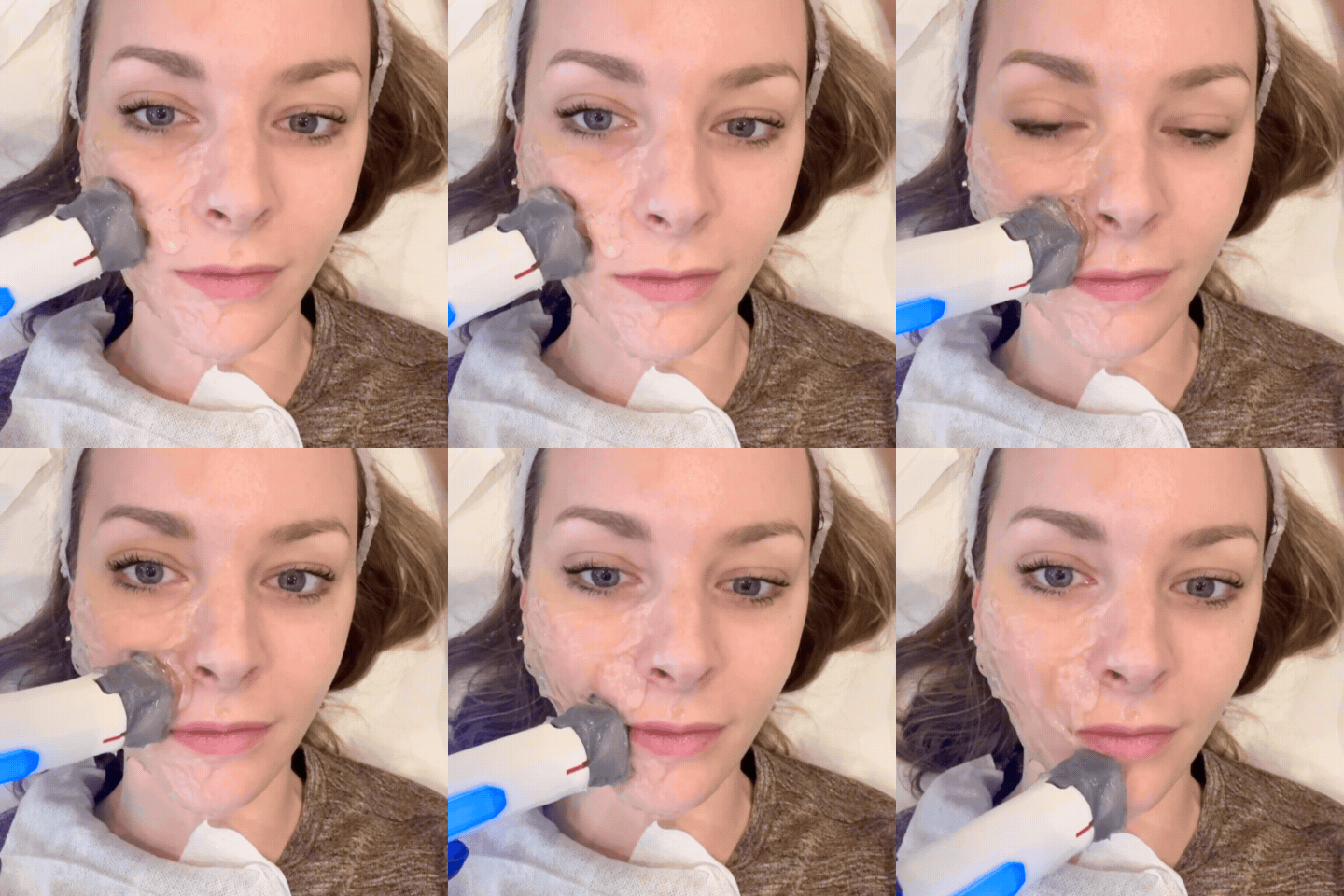
Next came the gel. And when I say gel, I mean almost comical amounts. Great trowelfuls of ultrasound gel were applied to my face until it was practically slopping off the sides. Not particularly glamorous, but apparently essential for the treatment.
Then came the radiofrequency energy itself. I’d been warned that the sensation would be hot—almost like burning—but not painful. I appreciate that this sounds contradictory, but it turned out to be remarkably accurate.
Each pulse starts with a gentle warmth before building into an intense, concentrated heat. At its hottest, the sensation is almost alarming, as though your skin ought to be burning, yet without the sharp pain you might associate with an actual burn.
There were a handful of moments when I instinctively pulled away from the heat, but any sensations of discomfort disappeared quickly, and I was able to continue without difficulty. Would I describe it as relaxing? Not exactly. But compared with many aesthetic treatments I’ve tried (Sculptra, Fraxel, cryolipolysis, to name a few), it was a walk in the park.
Each area took approximately 15 minutes, meaning my full face and neck appointment lasted around an hour and a half. Something worth bearing in mind if, like me, you have a habit of trying to squeeze aesthetic appointments into your lunch break.
Is There Any Downtime?
In my experience, none. Despite the intensity of the heat during treatment, my skin looked completely normal afterwards. There was no obvious redness, swelling, raised bumps or telltale marks. Certainly nothing that would have prevented me from heading straight back to work.
That said, experiences can vary. Dr El Muntasar explains that temporary redness, warmth, swelling or tenderness are possible, while more significant complications, including burns, pigmentation changes or unwanted changes in facial contour, are possible risks with thermal energy treatments. “Non-invasive doesn’t mean completely risk-free,” he cautions. The precise frequency of these complications with XERF has yet to be established, making practitioner experience, appropriate treatment settings and careful patient selection particularly important.

Does XERF Actually Work?
Immediately after treating one side of my face, my practitioner handed me a mirror so I could compare the two. And I could see a difference—just. It was subtle, very subtle, but the treated side appeared marginally tighter, particularly around the lower face. The corner of my mouth seemed slightly lifted, giving me the appearance of a faintly coy smile. My skin also felt tighter, almost as though the underlying tissues had been gently pulled taut.
I want to stress that these were not dramatic results. My own family wouldn’t have noticed a difference, and I certainly didn’t emerge looking as though I’d had anything done. But when you’re scrutinising your own face as closely as I was, those tiny changes can feel surprisingly satisfying.
More visible results are expected to develop over time. “Some patients notice an early tightening effect, but the more meaningful changes develop gradually over the following two to six months as collagen remodelling takes place,” explains Dr El Muntasar.
However, the industry’s convenient get-out-of-jail-free card applies here, as results can vary considerably depending on skin quality, anatomy and the degree of laxity being treated.
“I think the biggest misconception surrounding energy-based treatments is that they can dramatically lift significantly sagging tissues,” adds Dr El Muntasar. “In reality, XERF is better suited to subtle, natural-looking rejuvenation, improving skin quality, firmness and definition rather than fundamentally changing facial anatomy.”
It’s a refreshingly realistic assessment, particularly in an industry where before-and-after photographs can sometimes encourage rather unrealistic expectations.
Is XERF Worth It?
What impressed me about XERF wasn’t that it resulted in an immediate, dramatic transformation. It was how little disruption the treatment involved.
For something designed to stimulate collagen remodelling at different tissue depths, the experience was incredibly straightforward. There were no needles, minimal pain and no downtime. And though the immediate improvements were modest, I could just about see and definitely feel a difference.
Would I recommend it to someone expecting a dramatically lifted jawline or a solution to considerable sagging? No. But for someone beginning to notice a loss of firmness, who wants subtle refinements without committing to something more invasive, I give it the thumbs up.
I also think the excitement surrounding XERF needs to be balanced with an acknowledgement that it’s a relatively new technology, and that independent, long-term clinical evidence is still developing. Particularly when it comes to facial fat, I wouldn’t accept blanket assurances that any energy-based treatment is entirely without risk.
For now, my overall verdict is cautiously positive. The experience was considerably more comfortable than I’d anticipated, the lack of downtime is a huge advantage, and the immediate tightening was encouraging.
Whether that translates into a noticeably firmer, more sculpted face over the coming months remains to be seen. And, ultimately, that’s the result I’m most interested in.
