Everyone’s Trying Dopamine Menus—A Psychologist Weighs In on Whether They Actually Make You Happier
I went looking for a dopamine hit—what I found was better.


I can’t be the only one who treats chasing dopamine like a perfectly reasonable hobby. Think a good song, a sunny walk, an unnecessary coffee; or, ideally, all three before 10 am. So when “dopamine menus” started doing the rounds on my FYP, I was immediately sold. One: how fun. Two: the promise that by deliberately choosing little pleasures, I could give my brain the reward it needed to get me moving again? Sign me up.
Admittedly, the more I thought about it, the stranger the premise seemed. When did dopamine become something we thought we could manage with a five-point list? Online, we talk about it as if we can simply top it up, turning one of the brain’s most complicated chemical messengers into shorthand for pleasure, motivation and feeling good - and apparently decided we can curate our way to more of it.
But can we? Naturally, after having been thoroughly seduced by the concept, I did what any sensible person (and intrinsically curious journalist) would do: made one for myself, then asked actual neuroscientists and psychologists whether I’d been completely taken in.
Ultimately, I wanted to know what a menu like this actually does to the brain, whether it can genuinely support our wellbeing, and whether we’ve started overcomplicating the simple things that make us feel good, and, if so, whether I could build a better menu - without chasing the classic ‘dopamine hits.' For that and more, keep scrolling. And don't miss our guides to low dopamine mornings and dopamine fasting here.
Do Dopamine Menus Work? We Asked Top Experts
What Is a ‘Dopamine Menu’ Actually Doing To My Brain?
In the interest of time (my next dopamine fix waits for no woman), I wanted to first understand what a menu like this would actually be doing to my brain.
Because while I joke about dopamine constantly - usually when I’m stressed and reaching for my phone, a coffee or something sweet - I've never really stopped to think about what it actually is. I’ve treated it as a one-way ticket for feeling good, when, as neuroscientist Farah Qureshi explains, it’s doing something far more complicated.
“The brain is energy efficient and doesn’t necessarily like change,” she tells me. “It likes familiarity and predictions.” Dopamine, she explains, "is not simply a chemical signal for pleasure, but one of the brain’s gears that helps us recognise what is worth pursuing, learn from rewards and anticipate what might happen next."
That means when I see a friend, listen to music or finish something I’ve been putting off, I can absolutely talk about dopamine being involved, but it isn’t quite the “hit” I’ve been imagining. “This felt valuable, remember it and do it again,” is closer to the message, says Qureshi.
And this is where my very simple idea of dopamine starts to shatter slightly. It isn’t just about how good something feels; it’s also helping our brains learn what we value, what to expect and what might be worth doing again. A 2024 review in Nature Neuroscience found that while dopamine plays a key role in learning this, the familiar idea that it simply signals a “reward prediction error” doesn’t tell the whole story.
Can Choosing The Right Things Actually Make Me Feel Better?
When I sat down to curate my dopamine menu, I felt an almighty pressure to choose the “right” things. What genuinely brought me joy, rather than simply distracted me? What made me feel my most rested self? Suddenly, a list of things I liked doing felt like a surprisingly serious exercise in self-reflection - and I wondered whether this was genuinely useful or just another fad destined to disappear by next week.
Perhaps the answer partly comes down to how easy it is to follow through. Psychologist Tara Quinn Cirillo tells me that when we’re overwhelmed, even things that are good for us can feel overwhelming too. “There is a relationship between anxiety, mood and motivation,” she explains. “When our brains reach capacity, even deciding what might help can become another task. Preparing a list of restorative activities in advance can reduce that cognitive load and make us more likely to engage with them.”
And those things don’t have to be big. She points to a 2024 randomised controlled trial of 349 people that found that encouraging everyday behaviours - from meaningful activities to healthy habits to social connection and making plans - led to moderate reductions in depression and anxiety.
It’s an idea that Quinn Cirillo describes through the lens of “marginal gains”: rather than waiting for one big intervention to transform how we feel, small changes across different areas of our lives can, collectively, make a meaningful difference.
How To Stop Your Dopamine Menu Becoming Another Thing To Optimise
Now, I’m going to do something that feels slightly rebellious: strip away all the dopamine language. Why, I hear you whisper? Because the more I hovered over my list, the more I worried I was turning this experiment into another way to optimise my own wellbeing, to prove I was capable of looking after myself.
“Our brain chemistry is constantly responding to how we live: our relationships, movement, sleep, purpose, connection, stress levels and the things we enjoy,” Qureshi tells me. “So rather than constantly chasing a dopamine hit, I think it’s more about creating a life and habits that support the brain naturally.”
Enter science, which suggests the value of my menu might have less to do with getting a dopamine buzz, and more to do with making these small, intentional choices easier to reach for. A 2024 study put five simple wellbeing habits to the test: connecting with others, being active, taking notice, learning and giving. After 10 weeks, participants reported greater improvements in life satisfaction, positive emotions and overall wellbeing than the control group, alongside reduced anxiety and depressive symptoms.
So, it goes without saying, we don’t need one big wellbeing overhaul. The little things matter too - which made me feel better about the decidedly unscientific process of filling in my own menu.
That being said, Quinn Cirillo warns that focusing too heavily on dopamine can create a “tick-box” mentality, and this is exactly what we need to avoid. “We can start expecting every activity to deliver a hit of happiness, then feel deflated or self-critical when we don’t complete the list. And, she reminds me, rest and spontaneity matter too.” And, as she reminds me, rest and spontaneity matter too.
Perhaps, then, the real test of my menu isn’t whether it gives me a dopamine hit. It’s whether it makes choosing the things that support my wellbeing feel a little easier.
Forget Dopamine. Here’s What I Put On My Wellbeing Menu
By no means do I think I’ve created the perfect menu for every mood and moment - I’m not sure such a thing exists. But after two weeks of putting mine to the test, I have this to report back: forget what’s supposed to “boost” your dopamine. Think instead about what your brain actually needs. What calms you? Give you energy? What makes you feel connected, gets you out of a rut or leaves you genuinely restored?
That’s the structure I’ve followed: how I want to feel, rather than which dopamine hit I’m chasing. If you’re looking for inspiration, these are the things I’ve found myself reaching for - hopefully to support myself on the harder days, rather than give me something else to optimise.
When I'm Overwhelmed
Being told to “just sit in silence” when you have the hum of 47 tabs open can feel less like self-care and more like psychological warfare. So, when I’m overwhelmed, I’m not necessarily looking for nothing; I’m looking for the right kind of something.
Warm Light: There’s something about switching off the big light and replacing it with a warm, low glow that makes my entire body exhale. I’m not claiming my bedside lamp is a neurological intervention; there’s good reason to think light matters: brighter, blue-enriched light can promote alertness, while dimmer, warmer light can feel far less disruptive. So, when the atmosphere needs a change, I reach for the little amber lamp rather than adding another blast of stimulation. No fancy wellness gadget required.
Pick up a book: When my world feels particularly noisy, I like giving my brain somewhere else to go. A good book lets me swap the 17 tabs currently open in my head for one fictional universe - preferably one involving other people’s problems.
Learn something while moving. When I’m not obsessively reading about the latest innovation in women’s health, my other great love is history. So, I’ll take the dog for a walk and put on a history podcast or audiobook. Somehow, teaching myself about a 16th-century monarch while picking up after my dog is enough to make the modern world feel considerably less urgent.
When I'm Restless
This is the category for when I’m not overwhelmed exactly - I’m just itchy. I need stimulation, but the kind that leaves me feeling satisfied rather than like I’ve spent 45 minutes scrolling.
Change my environment. Sometimes I don’t need a new activity; I just need to stop looking at the same four walls. A café, library, park or even a touch of people watching can be enough to give my brain a reset.
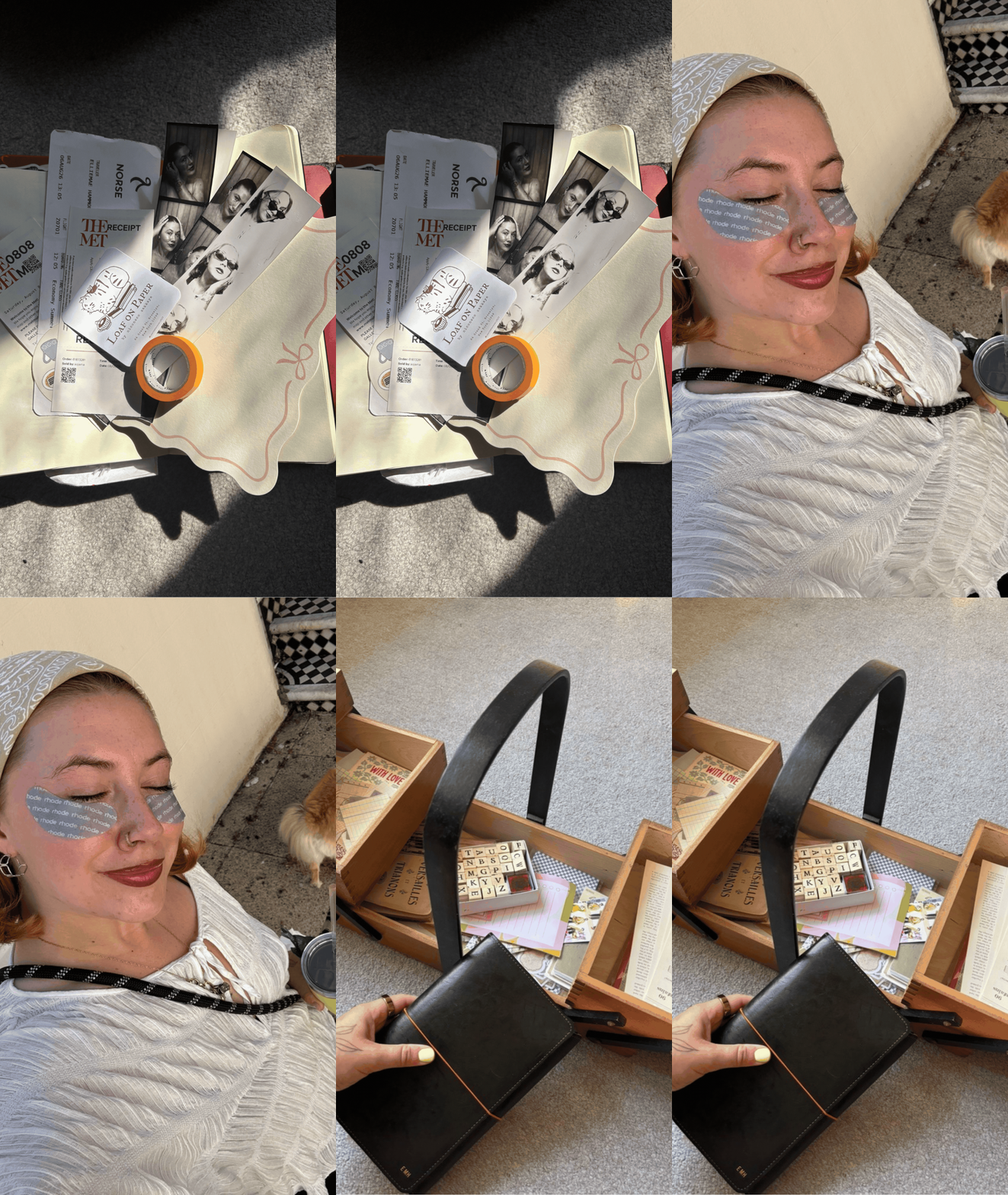
Journal. As a self-proclaimed journaling fanatic (a stationery shop hates to see me coming), I’ve put this one on a fairly high pedestal. Sometimes, I’ll give myself five minutes to write whatever is rattling around in my head; other times, I’ll spend an hour collaging a page. There’s no productivity goal here. It’s simply somewhere for my restless brain to put itself.
Make something. At the moment, that means watercolour painting. I am not, I should stress, particularly good at it, but perhaps that’s the point. There’s something wonderfully absorbing about giving your hands a task when your brain is desperate for entertainment.
When I Need To Recharge & Detach
The things I reach for when I don’t want to take in an influx of information, stimulation or productivity.
Give a hobby a time slot. Rather than waiting until I magically have “free time”, I set a timer and give one of my interests my full attention for a set period. There’s something really liberating about knowing I only have to do one thing for the next hour.
Start a project. I’ve recently started knitting again. I’m no expert - I can produce a scarf or blanket and little else - so I tend to pick a friend in need of either and give myself a deadline. It gives my brain something to work towards without the slightly exhausting requirement of it turning into a side hustle.
Book an exercise class. There’s something about having a commitment I actually have to show up for that switches my brain off. At the gym, I can spend 20 minutes wondering what I should train. In a class, someone else makes the decisions. My only job is to arrive and do what I’m told. Bliss.
Go outside. No headphones. Emphasis here on the no headphones. Sometimes, detaching means resisting the urge to fill every spare second with noise and companionship. A walk where I can hear the traffic, birds, my own footsteps - and, in my case, my dog yapping at every man in her peripheral area - can be surprisingly restorative.
Shop MC’s Mood-Boosting Menu Essentials:

My wellbeing menu has one very simple rule: when I need a reset, I have to actually leave the house. I’ve been testing the Yeti Ranchero Crossbody for exactly that - throwing in my phone, keys and the essentials, then heading out for a walk without giving myself time to overthink it. It’s small enough to stop me from packing half my life, which, frankly, is probably another wellbeing win.

Investing in a Kindle has quite possibly been one of the best additions to my wellbeing menu. When I’m overstimulated, I’ve learnt that the answer isn’t always another dopamine hit - sometimes it’s getting out of my own head and into someone else’s. One book, no notifications and considerably fewer opportunities to accidentally spend 45 minutes on my FYP.

At this point, I’ve trialled enough notebooks to qualify for a stationery degree. I eventually gave in and joined the Louise Carmen journal cult, but if you’re not quite ready to make that level of commitment, Papier’s personalised Monogram notebook is my more affordable alternative. It has the same satisfying grown-up feel, with a monogrammed cover and plenty of space to give all those restless thoughts somewhere to go.
