Marie Claire UK Marie Claire UK
  • Fashion Fashion
      • Fashion
        • View all Fashion
        • Fashion Trends
        • Shopping
        • Watches and Jewellery
        • Fashion News
  • Beauty Beauty
      • Beauty
        • View all Beauty
        • Fragrance
        • Hair
        • Make Up
        • Skincare
        • Nails
        • Marie Claire Beauty Awards
  • Health Health
      • Health
        • View all Health
        • Fitness
        • Nutrition
        • Female Health
        • Wellbeing
  • Life Life
      • Life
        • View all Life
        • Opinions
        • Travel
        • Sustainability
        • Weddings
        • Money & Work
        • Competitions
  • Culture Culture
      • Culture
        • View all Culture
        • TV and Film
        • Celebrity News
        • Books
        • Royal News
  • Vouchers Vouchers
      • Clothing
        • View all Vouchers
        • Mint Velvet
        • Karen Millen
        • H&M
        • nobody's child
        • ASOS
        • ARKET
        • MANGO
      • Designer Clothing
        • View all Vouchers
        • Reiss
        • THE OUTNET
        • SSENSE
        • Mytheresa
        • Liberty London
        • Selfridges
        • Farfetch
      • Accessories
        • View all Vouchers
        • AllSaints
        • Aspinal of London
        • Charles & Keith
        • River Island
        • FitFlop
        • Kate Spade
        • Vagabond
      • Jewellery
        • View all Vouchers
        • Pandora
        • Abbott Lyon
        • Goldsmiths
        • Beaverbrooks
        • Astrid & Miyu
        • Swarovski
        • Angara Jewellery
      • Beauty
        • View all Vouchers
        • Sephora
        • Cult Beauty
        • Space NK
        • Dyson
        • Clarins
        • Look Fantastic
        • Clinique
      • Activewear
        • View all Vouchers
        • Lululemon
        • Gymshark
        • Sweaty Betty
        • Nike
        • adidas
        • New Balance
        • Helly Hansen
  • NEWSLETTER Signup to our newsletter
  • logoCreated with Sketch.
    Marie Claire Newsletter

    Celebrity news, beauty, fashion advice, and fascinating features, delivered straight to your inbox!


    By submitting your information you agree to the Terms & Conditions and Privacy Policy and are aged 16 or over.

    You are now subscribed

    Your newsletter sign-up was successful


    An account already exists for this email address, please log in.
    Trending
    • Women in Sport 2026
    • Marie Claire Masters
    • Autumn Winter 2026
    • Nail Trends 2026
    • Best Investment Bags
    • Best Perfumes
    1. Life
    2. Sustainability

    The Devastating Reality Of Fashion Slavery: The Power Is In Your Hands

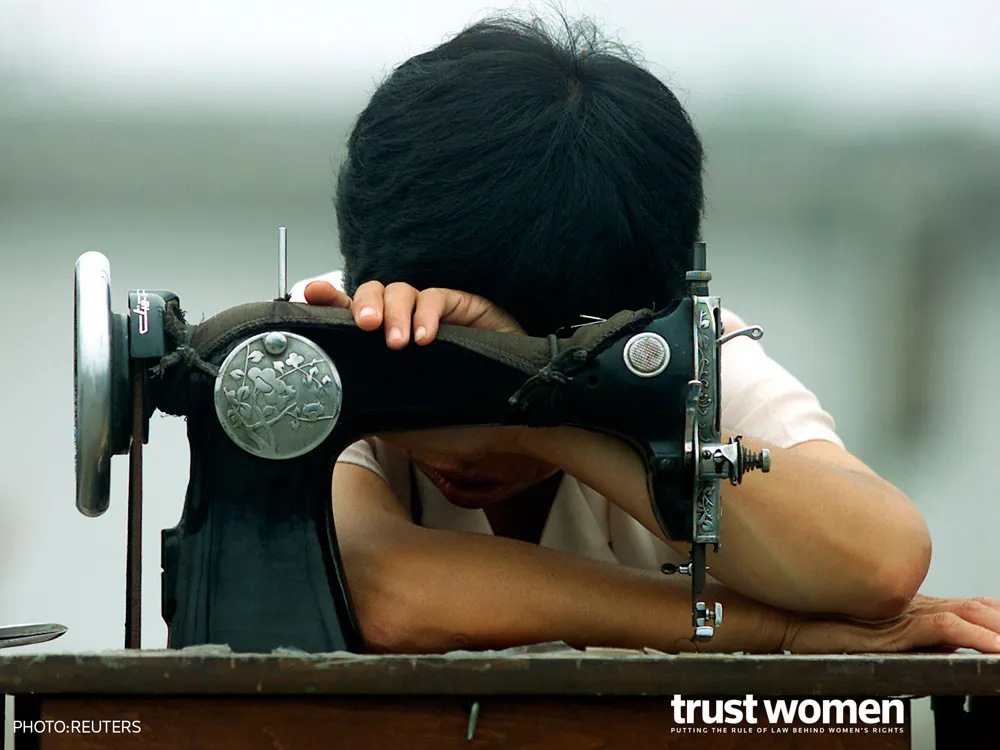
    Livia Firth, Creative Director of Eco Age, and Monique Villa, CEO of Thomson Reuters Foundation, explain why fashion slavery affects us all...

    By Marie Claire
    Published 6 November 2014 In Reports

    When you purchase through links on our site, we may earn an affiliate commission. Here’s how it works.

    • Facebook
    • X
    • Pinterest
    Share this article
    Join the conversation
    Follow us
    Add us as a preferred source on Google
    Subscribe to our newsletter

    Livia Firth, Creative Director of Eco Age, and Monique Villa, CEO of Thomson Reuters Foundation, explain why fashion slavery affects us all...

    Every single day we perform two simple acts: we eat and we get dressed. But while people are becoming increasingly careful about the food they buy, when it comes to fashion, the origin of the products is still a question that remains mostly unaddressed.

    Over the past decade, along with cheap clothes we have also been sold a myth: that buying a t-shirt at two dollars is a democratic right of our times. The truth is that there is nothing democratic about the principle of buying clothes at unrealistic prices. The equation is simple: if we want more clothes on the racks faster, workers must produce faster. And if we want our garments to cost less, then production – including salaries – must cost less.

    In what has become a global rush to ‘fast-fashion’, high street brands demand a weekly, constant turnover of new collections, stock is kept intentionally low to trigger impulse buying, and supply chains are expected to respond to the latest trends, switching production in a matter of hours. As a result, clothes are cheaper than ever, fuelling the earnings of the global garment industry, worth some 3 trillion dollars per year.

    Last year, the collapse of a factory complex at Rana Plaza in Bangladesh - a factory that had produced garments for some popular Western brands - killed almost 1,200 workers. It was the world’s worst industrial accident in 30 years, and it highlighted the human costs of fast fashion, prompting the general public to begin to ask the important question: who is behind the clothes that we wear?

    You may like
    • Oxfam “The Water Used to Produce Britain’s Unworn Clothes Is Enough to Supply 1 Million People for a Lifetime”: Oxfam’s Latest State of Style Report Finds
    • Eva Omaghomi After 17 years in the Royal Household, Eva Omaghomi Talks Bringing African Design Talent to Harrods
    • Jenny Lai Luxury Shoppers Put This One Thing Above All Else When Spending Their Money—And It’s Not What You Think

    The answer is often linked to a complex dynamic, an exploitation mechanism which lies at the bottom of the modern supply chain, and which has its roots in poverty, negligence, and most of all, corruption, the grease that fuels modern day slavery. According to Walk Free, there are nearly 30 million people enslaved around the world, the highest number in history, and roughly equivalent to the population of Australia and Denmark combined. Sadly, human trafficking is a fast-growing business, one worth nearly £90 billion ($150 billion) a year, more than the GDP of most African countries, and three times the profit of Apple combined.

    Livia Firth, Creative Director of Eco Age

    Marie Claire Newsletter

    Celebrity news, beauty, fashion advice, and fascinating features, delivered straight to your inbox!

    By submitting your information you agree to the Terms & Conditions and Privacy Policy and are aged 16 or over.

    Slavery is a global issue, and one that goes well beyond the fashion industry. Recent reports have highlighted the plea of Nepalese builders in Qatar, paid 45p an hour on 20-hour-long workdays, and Burmese immigrants in Thailand who are trafficked, brutally beaten and enslaved at high seas to fish the prawns that end up on our plates.

    Today, if you compare state GDP to net profits, global corporations are bigger and more powerful than many nation states. However, these trans-national entities have very little to be accountable for. Supply chains are becoming increasingly long and complex, and they are often outsourcing responsibility to third party certification schemes that in reality don’t guarantee much at all. The reality is that even when corporations want to do the right thing, often they don’t know what exactly goes on in their supply chains.

    And then there’s corruption. Many of the factories in Bangladesh where underpaid workers lost their lives, as well as hundreds of Indian factories where young girls are the victims of bonded labour, have been 'ethically audited'. Some of these audits are nothing more than lucrative corrupted shams run by local companies, outsourced by big multinationals.

    What to read next
    • Poppy Wang 5 Experts Explain the Nuances of the ‘Mandarin Jacket’ Trend
    • Female athletes crossing the finish line at a track and field event Why We Should Care About Sexualisation in Women's Sport—and How It’s Bigger Than Sydney Sweeney
    • lisaingmarinelli wears yellow dress niche brands Tired of Wearing the Same Brands? Meet 7 Lesser-Known Labels the Marie Claire Fashion Experts Think You Should Know

    According to the UN, both governments and business share a principle of responsibly. In other words, states have an obligation to set fair legal minimum wages, and businesses must pay wages accordingly. But the UN framework also clearly states that if governments fail to set appropriate pay standards, businesses still carry an obligation to respect the human right to a living wage, and therefore must be ready to take initiative accordingly.

    Monique Villa, CEO of Thomson Reuters Foundation

    An increasingly global economy calls for international standards and regulations. We have strict and well defined safety and regulation standards across the airline industry, why shouldn’t we have universal meaures to keep slavery out of the supply chains?

    But global regulation is certainly not the only answer. In fact, if we use the market as a force for good we could see change at a much faster pace. Governments can take years to pass laws, and then perhaps never enforce them, while major corporations have the capacity to immeditaly pay fair and realistic production prices, and to switch suppliers in a day, making a real impact across the market, and changing the lives of millions of individuals simply by virtue of deciding how to source and to retribute their workers.

    A living wage is a human right, and it is crucial that consumers are fully aware of the power in their hands. We’ll know we are on the right track only when we will see a £5 dress as a red flag, and not as a bargain.

    Slavery in the supply chain is one of the themes of the upcoming Trust Women conference in London, 18-19 November.

    Marie Claire
    Social Links Navigation

    The leading destination for fashion, beauty, shopping and finger-on-the-pulse views on the latest issues. Marie Claire's travel content helps you delight in discovering new destinations around the globe, offering a unique – and sometimes unchartered – travel experience. From new hotel openings to the destinations tipped to take over our travel calendars, this iconic name has it covered.

    Read more
    Oxfam
    Fashion “The Water Used to Produce Britain’s Unworn Clothes Is Enough to Supply 1 Million People for a Lifetime”: Oxfam’s Latest State of Style Report Finds
    Eva Omaghomi
    Fashion After 17 years in the Royal Household, Eva Omaghomi Talks Bringing African Design Talent to Harrods
     
     
    Jenny Lai
    Fashion Luxury Shoppers Put This One Thing Above All Else When Spending Their Money—And It’s Not What You Think
    Poppy Wang
    Fashion 5 Experts Explain the Nuances of the ‘Mandarin Jacket’ Trend
     
     
    Latest in Sustainability
    UK heatwave
    Sustainability I'm a Climate Communicator: Britain's Heatwaves Feel Like Summer—But They're a Sign of Something Much Bigger
    Jodie Kidd
    Sustainability Jodie Kidd on Fashion, Fast Cars and Finding a Second Career in Motorsport
     
     
    Earth Month sustainable brands
    Sustainability Craft Is Everywhere In Fashion Right Now, But At This Studio, It’s A Way Of Life.
    Green Gap: Archival Fashion
    Sustainability Move Over, Fast Fashion—The Rise of Archive Economy Just Made Your Wardrobe Fashion’s New Power Source
     
     
    Latest in Reports
    The Fertility Gold Rush
    Female health The Fertility Gold Rush — How Big Business Took Over Baby-Making
    Kansas City Chiefs NFL player Harrison Butker giving a press conference
    Life Harrison Butker's speech about women's role as "homemakers" is being widely criticised
     
     
    Online safety violence against women
    Culture “Our appetite for watching women fail does contribute to the rest of our behaviour online.”
    Oscar Pistorius leaves the North Gauteng High Court in 2016 in Pretoria, South Africa
    Life Reeva Steenkamp's mother has spoken out as Oscar Pistorius is released on parole
     
     
    logoCreated with Sketch.
    • Site Archive
    • Contact Future's experts
    • Contact us
    • Terms and conditions
    • Advertise with us
    • Privacy policy
    • Cookies policy
    • About us
    Add as a preferred source on Google Add as a preferred source on Google

    Marie Claire UK is part of Future plc, an international media group and leading digital publisher. Visit our corporate site.

    © Future Publishing Limited Quay House, The Ambury, Bath BA1 1UA. All rights reserved. England and Wales company registration number 2008885.